
Julia Leo – House of mona
It was never a goal or a conscious decision. Drawing was always there. Before painting, there were already lines: on walls, on the margins of notebooks, on my own skin. Any surface could become a support. Painting came later, almost without announcing itself, as a natural drift from that initial gesture. It wasn’t a choice, but a continuation, the same impulse finding another way to manifest itself.
Nunca fue un objetivo ni una decisión consciente. Dibujar estuvo siempre ahí. Antes de la pintura, ya había líneas: en las paredes, en los márgenes de los cuadernos, en mi propia piel. Cualquier superficie podía convertirse en soporte. La pintura llegó después, casi sin anunciarse, como una deriva natural de ese gesto inicial. No fue una elección, sino una continuidad: el mismo impulso encontrando otra forma de manifestarse.


¿De dónde viene tu apodo?
Where does your pseudonym come from?
– House of surge de la cultura ballroom queer, donde las Houses funcionaban como familias elegidas: espacios de contención, identidad y pertenencia para personas que muchas veces quedaban fuera de los marcos tradicionales. No eran solo nombres o estéticas, sino estructuras simbólicas donde habitar. En mi caso, cuando hacía roller derby, mis compañeras me decían Mona. De ahí viene el nombre. House of Mona no es un colectivo ni un personaje fijo, sino una casa imaginaria elegida, un territorio personal de exploración. Un espacio de contención para una identidad que no es .estable ni única, sino variable, fluida y en constante transformación.
– House of comes from queer ballroom culture, where Houses functioned as chosen families: spaces of support, identity and belonging for people who were often excluded from traditional frameworks. They were not just names or aesthetics, but symbolic structures to inhabit. In my case, when I was doing roller derby, my teammates used to call me Mona. That’s where the name comes from. House of Mona is not a collective nor a fixed character, but an imagined, chosen home, a personal territory of exploration. A space of containment for an identity that is not stable or singular, but variable, fluid, and in constant transformation.


¿Qué piensas de la idea de publicar tus piezas con una entrevista en elrincondelasboquillas.com?
What do you think about the idea of us publishing your artworks on our web «elrincondelasboquillas.com»?
•Me siento honrada por el interés y la invitación. Al ver el nivel y la trayectoria de los artistas que publican en la plataforma, el agradecimiento es aún mayor. Valoro mucho la oportunidad.
– I feel honored by the interest and the invitation. Seeing the level and trajectory of the artists published on the platform makes the appreciation even greater. I truly value the opportunity.


¿Te acuerdas de la primera pieza?
Do you remember the first piece?
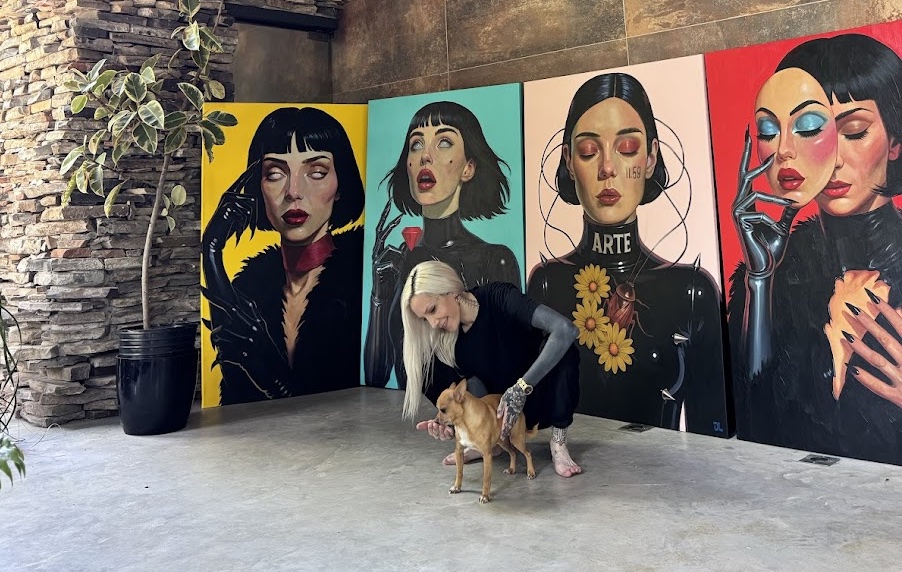
•Para mí nunca hubo un soporte “correcto”. Cualquier cosa que estuviera al alcance podía funcionar: paredes, hojas, cuadernos, manos. Eso estuvo siempre. El bastidor apareció bastante después. La primera vez que pinté en uno tenía alrededor de 14 años, principalmente porque mis hermanos pintaban y me dieron ganas de probar ese formato. Lo primero que pinté fue un diablo, mirando directo a los ojos. No estaba en un gran momento, claramente, y fue lo que salió. No hubo mucha reflexión detrás, solo la necesidad de hacer lo que tenía ganas de hacer en ese momento. Supongo que mi relación con la pintura sigue siendo bastante esa. Durante mucho tiempo me costó pintar, y sobre todo mostrar lo que hacía. Mostrar un cuadro para mí se sentía muy parecido a quedarme desnuda: demasiado expuesta, demasiado vulnerable. Sentía que cualquier cosa que pintara podía delatar algo que no quería mostrar. Pasé bastante tiempo escondiéndome de mí misma, por distintas razones.
– For me, there was never a “correct” support. Anything within reach could work: walls, sheets of paper, notebooks, hands. That was always there. The canvas came much later. The first time I painted on one I was around 14, mainly because my brothers were painting and it made me want to try that format. The first thing I painted was a devil, looking straight into the eyes. I wasn’t in a great moment, clearly, and that’s what came out. There wasn’t much reflection behind it, just the need to do what I felt like doing at that moment. I guess my relationship with painting is still pretty much that. For a long time, painting was difficult for me, especially showing what I made. Showing a painting felt very similar to being naked: too exposed, too vulnerable. I felt that anything I painted could give something away that I didn’t want to reveal. I spent quite a long time hiding from myself, for different reasons.


Y para terminar ¿algo que quieras decir?
And finally, anything you want to say?
– Primero que nada, quiero agradecer a Vicent por la invitación y por el interés en mi trabajo. También me gustaría dejar un mensaje. Hagas lo que hagas, no lo fuerces a encajar en ningún lado, más que en tu propia coherencia.
First of all, I’d like to thank Vicent for inviting me and for the interest in my work. I’d also like to leave a message: whatever you do, don’t force it to fit anywhere other than within your own coherence
Instagram: @julialeo